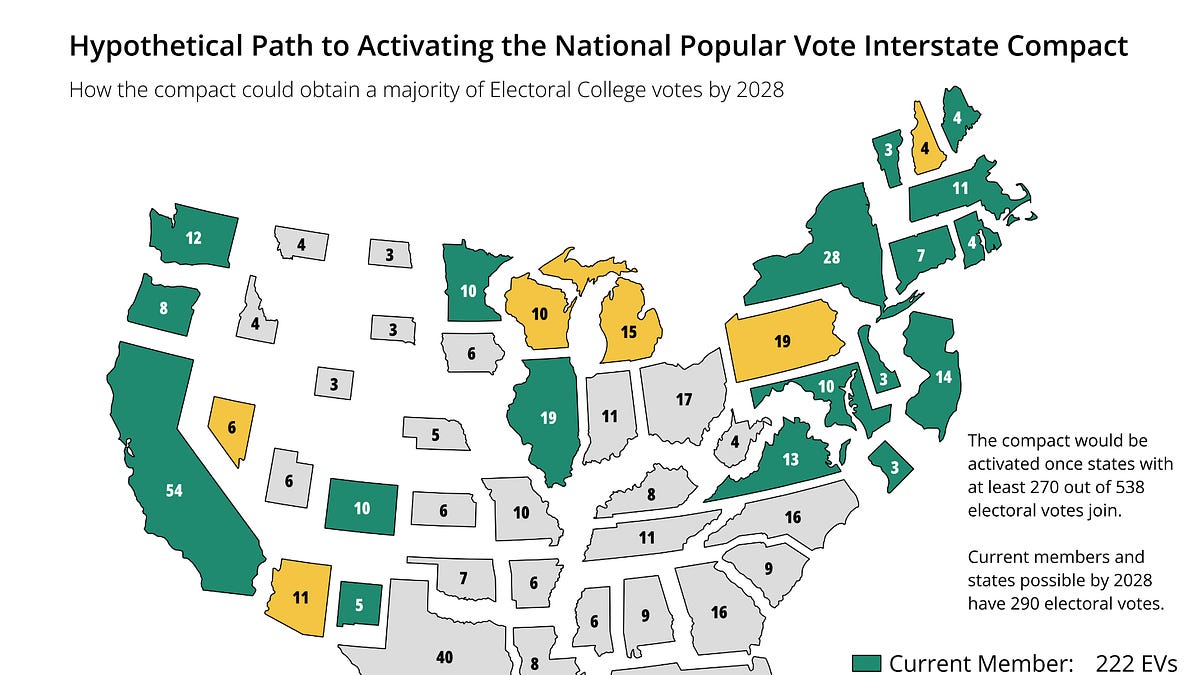
For decades, the mechanics of the Electoral College have been a source of intense debate in American politics. The system—where presidential elections are decided state-by-state rather than by the overall national vote count—has twice in this century resulted in a candidate taking the White House while losing the national popular vote. However, a movement that began nearly two decades ago is quietly approaching a threshold that could fundamentally transform how the nation chooses its president.
The strategy does not rely on a constitutional amendment, which requires approval from two-thirds of Congress and three-quarters of the states—a virtually impossible bar in today's polarized environment. Instead, it relies on a state-level policy solution known as the National Popular Vote Interstate Compact (NPVIC).
How the Compact Works
First introduced in 2006, the NPVIC is an agreement among states to award all of their electoral votes to whichever presidential candidate wins the nationwide popular vote, regardless of who wins within their individual state borders.
The compact contains a critical trigger mechanism: it only goes into effect once joined by states possessing a majority of the electoral votes—specifically, 270 of the 538 total. Until that threshold is reached, participating states continue to award their electoral votes according to their existing state laws.
To date, 19 jurisdictions (18 states plus the District of Columbia) have joined the compact, representing 222 electoral votes. That leaves the coalition just 48 votes short of the 270 required for activation. Because every state that has passed the compact so far did so under Democratic legislative control, the near-term fate of the initiative hinges largely on state-level election outcomes where Democrats have opportunities to secure full government control.
The Legal and Political Hurdles Ahead
Even if the compact reaches the necessary 270 electoral votes, its implementation is expected to trigger unprecedented legal and political challenges. Opponents argue that the compact circumvents the intent of the U.S. Constitution, pointing specifically to the Compact Clause, which restricts agreements between states without congressional approval.
Proponents counter by pointing to Article II, Section 1 of the Constitution, which explicitly grants states broad authority to appoint presidential electors in whatever manner their legislatures direct. Because state legislatures currently choose to use a winner-take-all popular vote model within their borders, advocates maintain states have the full legal right to allocate those same electors based on the national vote instead.
The potential for conflict has drawn sharp reactions across the political spectrum. Some observers warn that bypassing the established framework could provoke severe resistance or destabilize trust in the results.
"Popular vote would be a disaster for the country and lead to an eventual civil war. This is by far the dumbest fucking idea ive ever seen.q"
Others argue that moving to a popular vote system is essential for democratic fairness, ensuring that every citizen's ballot carries equal weight regardless of geographic location.
"That would be kinda wild.
A Wyoming voter has a 67x more powerful vote than a California voter when it comes to representation in the senate. He's gonna start a war because he loses his 3x more powerful vote for the presidency?
Nvm the fact that a popular vote would incentivize presidents to actually talk to voters outside of the swing states."
If the compact were activated, it could also face high-stakes constitutional reviews in federal courts. Critics maintain that the judiciary would swiftly intervene to halt the arrangement.
"The currently constituted SCOTUS will, 100% guaranteed, rule the National Popular Vote compact to be unconstitutional.
Reducing the power of small rural red states? Not a chance."
Yet legal scholars remain divided on whether a constitutional basis exists to strike down a state's explicit authority to direct its electors.
"They've made some horrible rulings, but a ruling that this is unconstitutional would be an uphill slog even for these justices. The Constitution plainly gives states the power to decide how their elections are run. If a majority of states agree to assign their electoral votes to the candidate who wins the popular vote, I don't see any basis for it to be declared unconstitutional. Like, I don't know what they'd be able to write in the ruling. But who knows. We'll have to wait and see."
Alternative Reform Pathways
As the debate over the interstate compact continues, reform advocates point to other structural changes that could make presidential elections more representative without altering the underlying electoral system. Two widely discussed alternatives focus on the legislative branch itself:
- Proportional Electoral Allocation: Moving away from state-level winner-take-all rules and instead awarding electoral votes proportionally based on the state's popular vote split. This would force presidential campaigns to compete across the entire map rather than focusing exclusively on a handful of battleground states.
- Uncapping the House of Representatives: Expanding the size of the U.S. House of Representatives beyond its current 435-member cap, which was established by the Permanent Apportionment Act of 1929. Because a state's electoral vote total equals its House seats plus its two Senate seats, expanding the House to reflect population growth would naturally reduce the mathematical skew that favors smaller states.
"Uncapping the House is actually a far more important reform. Not only would smaller districts provide a more reasonable and responsive representation, they are harder to gerrymander and increasing the number of members would dilute the effect of money on politics. Doubling the members is likely insufficient."
For now, the National Popular Vote Interstate Compact remains the most direct active campaign attempting to reform presidential elections. Whether it reaches the 270 electoral vote threshold—and survives the inevitable legal battles that follow—will shape the future of American federalism for generations to come.

